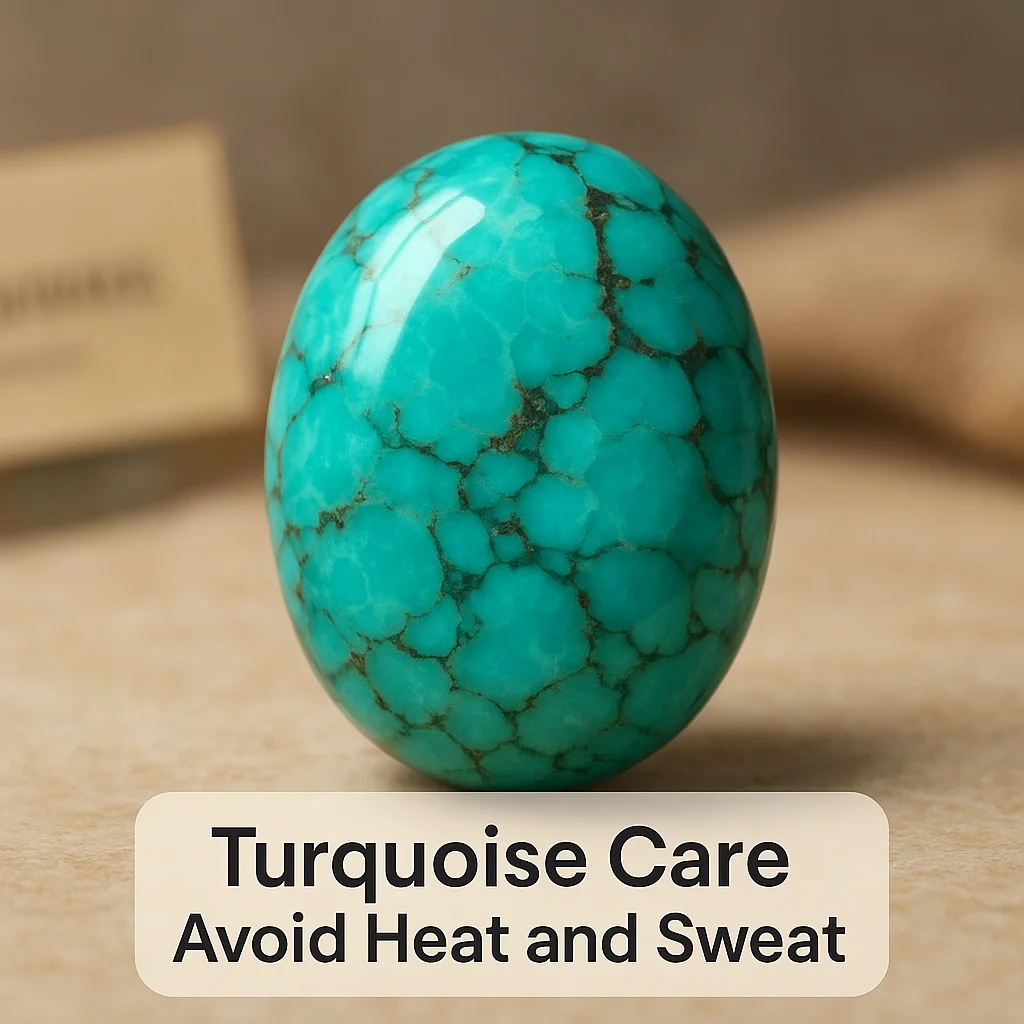
💎 Turquoise Care Avoid Heat and Sweat
🪨 What It Is
Turquoise is a vibrant, blue-to-green mineral widely cherished for its unique beauty. It falls under the category of hydrous phosphate minerals. The characteristic color of turquoise makes it a favored choice for jewelry and ornamental objects. This gemstone is also recognized as an important birthstone for December, often found in a range of cultural jewelry traditions.
The goal of this article is to familiarize readers with turquoise by discussing its appearance, properties, origin, value, and care. We will also provide tips for purchasing and maintaining turquoise jewelry, ensuring that beginners can appreciate and care for this distinct gemstone with confidence.
Readers will learn not only about the gemstone's considerable beauty but also the practical aspects of choosing quality pieces, understanding its formation, and protecting it from damage. The care instructions focus on avoiding heat and sweat, which can be particularly detrimental to the stone.
🌍 Where It Comes From
Turquoise is found in arid regions where rocks rich in copper and aluminum are present. It develops as a secondary mineral when water percolates through these copper-rich deposits. This fascinating process often takes place in sedimentary and weathered volcanic rocks, as well as in areas with minimal vegetation and limited rainfall.
Some of the most renowned turquoise deposits can be found in countries like the United States, Iran, China, and Egypt. Each of these regions produces turquoise with slightly different characteristics, having varied hues and levels of matrix, the pattern or web of host rock present in the stone.
Origin significantly influences turquoise's market reputation, and buyers often seek specimens from specific regions due to well-established preferences for clarity or hue. For example, Persian turquoise, which is sourced from Iran, is often considered one of the highest quality due to its rich, sky-blue color and minimal matrix.
🔬 How It Forms
The formation of turquoise is an intricate process involving specific atmospheric and geological conditions. It primarily requires the presence of copper, aluminum, and phosphorus-rich water. These elements undergo chemical reactions under the surface of Earth, slowly forming turquoise deposits over thousands of years.
This mineral typically presents as a microcrystalline structure, which means the crystals are so small that they are observable only under a microscope. Turquoise is commonly found in nodules, encrustations, or as a vein-filling in the host rock. Its color can vary depending on the amount of copper or iron present, with more copper resulting in a deeper blue shade.
🎨 Color and Look
Turquoise is celebrated for its stunning spectrum of blue and green hues. The most prized turquoise exhibits a solid, uniform color known as "robin's egg blue" or "sky blue". However, the presence of iron can lead to greener stones, which are also quite popular.
In addition to its vibrant colors, turquoise may display a unique matrix pattern, which often takes the form of spider-web-like veining. This pattern is due to the stone’s formation within the host rock. The look of turquoise can be significantly influenced by how it is cut and polished, as well as the environment in which it is viewed.
Dyeing and stabilization treatments are quite common for turquoise to enhance its color and strength, as the mineral is naturally porous. It's important for buyers to ask about any treatments, which can impact both the appearance and durability of the stone.
🧪 Properties That Matter
Turquoise rates between 5 and 6 on the Mohs hardness scale, which means it’s moderately resistant to scratches but not as hard as gems like quartz or sapphire. This property makes it more suitable for pendants and earrings rather than daily-wear rings that endure harsher conditions.
The toughness of turquoise, or its resistance to chipping and breaking, is considered fair. It can break if dropped or knocked sharply, so it requires care during daily usage. It generally exhibits a waxy to subvitreous luster, adding to its mystique and attractiveness.
Turquoise does not exhibit cleavage, but it does have an uneven fracture, meaning it may chip or snap rather than splinter. Understanding these properties helps in selecting the right types of jewelry for different lifestyles and occasions.
✨ Meanings, Birthstones, and Culture
Turquoise is celebrated worldwide not only for its beauty but also for its cultural significance. Traditionally, it is associated with protection and healing in various cultures around the globe. Despite these associations, it's crucial to approach such claims with an understanding that they are rooted in tradition, not scientific evidence.
As the birthstone for December, turquoise is often gifted to individuals born in this month. It is considered to bring good fortune and peace, adding personal and symbolic value to the stone.
In modern jewelry traditions, turquoise is prominently featured in Native American pieces, where it is meticulously inlaid or set in silver. These distinct designs highlight the stone’s vibrant hues and are a testament to its enduring allure.
🧼 Care and Cleaning
Because turquoise is porous and can be sensitive to chemicals, care should be taken to clean it gently with mild soap and water. It’s advisable to use a soft cloth for drying, avoiding abrasive materials that could scratch the surface.
A key aspect of turquoise care is to avoid exposing it to heat and sweat, as both can alter its color and luster. Rapid temperature changes or prolonged exposure to moisture can compromise the stone’s integrity.
When storing turquoise, keep it separate from harder gemstones to minimize the risk of scratching. Ideally, store in a soft pouch or lined jewelry box to enhance its longevity.
🛒 Buying Tips and What to Check
Several factors influence turquoise's price and quality, including its color, clarity, cut, carat size, and origin. It’s often recommended to seek specimens with an even color and minimal matrix if a solid blue appearance is desired.
When purchasing turquoise, inquire about any treatments that the stone may have undergone, such as stabilization or dye enhancement. A lab report can provide additional assurance of a stone's authenticity and quality but understand it won't categorically guarantee origin.
For online purchases, check seller reviews, return policies, and ensure there are clear, high-quality photographs of the gemstone. Transparency and reputation are critical when choosing stones without a physical inspection.
⚠️ Real vs Fake and Common Look-Alikes
It's crucial to distinguish between natural turquoise, synthetic versions (lab-grown), and imitations like dyed howlite or plastic. Synthetic turquoise is chemically identical but lacks natural inclusions and matrix patterns.
Imitation turquoise can often be identified by its lighter weight and uniform color. Materials like dyed magnesite or resin composites are also common imitations, lacking the natural variation found in genuine stones.
Detection of these differences requires professional testing. It’s advisable to consult with experienced gemologists to confirm authenticity to avoid misidentification, especially for higher-value pieces.
❓ Common Questions and Misconceptions
Is turquoise a mineral or a rock? Turquoise is a mineral, composed primarily of copper and aluminum phosphates.
Is turquoise a birthstone? Yes, turquoise is the birthstone for December.
Will turquoise scratch easily? With a Mohs hardness of 5 to 6, it's moderately scratch-resistant but should be worn with care.
Can turquoise go in water? Brief contact is fine, but prolonged exposure can harm the stone over time.
Does turquoise color fade in sunlight? Prolonged exposure to sunlight can lead to color fading; storage in a dark place is recommended.
What treatments are common for turquoise? Stabilization to enhance durability and dyeing for color enhancement are common.
Is lab-grown turquoise "fake"? Lab-grown turquoise is chemically identical but not naturally formed; it is a synthetic version.
How do I store turquoise safely? Store separately from harder stones in a soft pouch or lined box to prevent scratches.
Do inclusions always lower turquoise's value? Inclusions, or matrix, contribute to the unique charm of a piece but can vary the price based on personal preference.
How do I pick a good turquoise for jewelry? Look for even color, minimal matrix if preferred, and ensure quality setting and craftsmanship.
📌 Summary
- Turquoise is a captivating mineral and December birthstone, cherished for its blue-green hues.
- Colors range from sky-blue to green, with a matrix pattern due to host rock veining.
- Formation involves copper-rich deposits and requires specific geological conditions.
- Properties include moderate hardness and fair toughness, making it suitable for occasional wear.
- Common treatments include stabilization and dyeing to enhance color and strength.
- Care involves gentle cleaning, avoiding heat, and periodic inspections for damage.
- Best used in pendants and earrings to minimize wear-related risks.
- Common look-alikes include dyed howlite and synthetic substitutes.
- Authenticity confirmation relies on professional gemological testing.
- Buying tips include verifying treatments, checking seller reputability, and ensuring clear photos.
- As a birthstone, turquoise holds traditional cultural significance but not scientifically proven effects.
- Remember, turquoise's value adds a special element to December-born individuals and elegant jewelry designs.