💎 Basalt
🪨 What It Is
Basalt is an igneous rock, primarily composed of plagioclase and pyroxene minerals. Unlike gemstones, basalt is not typically used in jewelry due to its dark color and lack of luster. Instead, it's valued for its durability and abundance in the Earth's crust.
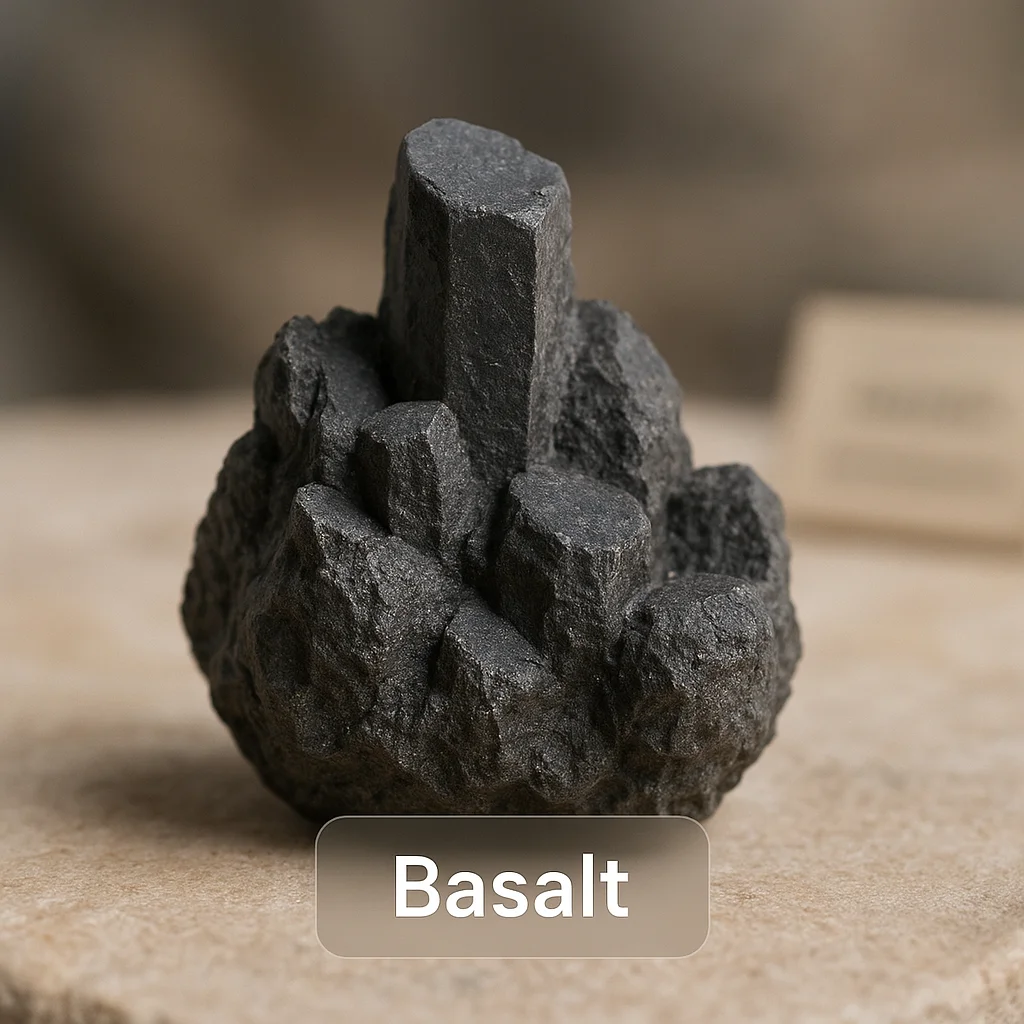
Basalt is one of the most common rocks found on Earth and is essential for understanding geological processes. For those interested in geology and mineralogy, basalt provides a fascinating insight into volcanic activity and the formation of the Earth's surface.
This article will delve into the appearance, properties, formation, and care of basalt. While it may not commonly feature in jewelry collections, understanding basalt is key to appreciating many of our planet's natural landscapes.
🌍 Where It Comes From
Basalt occurs naturally as an extrusive igneous rock, meaning it forms from lava that solidifies on the Earth's surface. It's produced in regions with volcanic activity, such as mid-ocean ridges, hot spots, and continental rift zones.
This rock is notably found in places like Hawaii, Iceland, and regions along the Mid-Atlantic Ridge due to the extensive volcanic activity in these areas. Basalt formations also exist in various parts of Africa, Asia, and North America.
Origin can influence basalt's appearance, such as whether it presents in hexagonal columns, as seen in the Giant's Causeway in Northern Ireland. Geologists can often trace basalt to its geographical roots based on these unique structures.
🔬 How It Forms
Basalt forms when molten rock, or magma, erupts onto the Earth's surface and cools rapidly. It originates deep within the Earth's mantle, where high temperatures and pressures melt the rock.
As magma rises through volcanic vents, it loses heat quickly, creating the fine-grained texture basalt is known for. Its rapid cooling prevents large crystals from forming, unlike slower-cooled igneous rocks.
This rock often forms in massive lava flows, extensive sheets of rocky terrain that demonstrate the volcanic origins of basalt. In some cases, these flows result in the beautiful hexagonal prisms seen in famous basalt formations.
🎨 Color and Look
Typically, basalt appears as a dark gray to black rock, although it can occasionally have a slight green or red tint, depending on the mineral content and oxidation. Its dense, fine-grained texture is due to the quick cooling of lava at the Earth's surface.
Basalt's appearance is generally consistent and does not undergo treatments like dyes or heat, unlike many gemstones. Its uniformity makes it a popular choice for construction materials.
While basalt lacks the vibrant colors and clarity of gemstones, it can showcase interesting surface patterns formed by bubble holes left from gases escaping during cooling.
🧪 Properties That Matter
The Mohs hardness of basalt typically ranges around 6, making it relatively durable and scratch-resistant. Its toughness means it resists chipping well, which is why it's often used in construction.
Basalt does not have cleavage, meaning it does not break along flat planes, but rather fractures in an irregular manner. This property can affect how it's used in mosaic or architectural applications.
Though basalt is not transparent and lacks luster, it's a robust material, making it suitable for landscaping, tiles, and other practical uses rather than jewelry.
✨ Meanings, Birthstones, and Culture
While basalt is not traditionally associated with birthstones, it holds cultural significance for many communities living near volcanic regions. It has been used historically in tools and building materials due to its abundance and durability.
In some cultures, basalt is symbolically linked to strength and protection, likely due to its origins in fire and its robust nature. These associations are cultural and not based in scientific evidence.
Modern uses of basalt in design and sculpture continue to honor its natural beauty and cultural heritage, although it remains outside the main jewelry narrative.
🧼 Care and Cleaning
To care for basalt items, simple soap and water are generally sufficient. Avoid harsh chemicals that may damage the stone or any applied finishes.
It's crucial to dry basalt after cleaning to prevent water spots, especially if the stone is polished. Using a soft cloth helps maintain its appearance.
When storing basalt, ensure it is placed with other durable materials to prevent scratches or damage, particularly if the stone is carved or has decorative finishes.
🛒 Buying Tips and What to Check
When purchasing basalt items, consider the stone's color uniformity and the quality of any finishes or polishes applied. These factors strongly influence its aesthetic appeal for decorative uses.
Ask about the origin of the basalt and any treatments it may have undergone, especially if marketed as unique formations or designs.
For high-value basalt pieces, a lab report might detail geological origins, although for most buyers, visual inspection and personal preference will play key roles in selection.
⚠️ Real vs Fake and Common Look-Alikes
Basalt is unlikely to be synthesized or imitated due to its availability and low cost. However, imitations might be crafted from composites if specific physical properties are desired.
Look-alikes such as black granite are sometimes misidentified as basalt. These rocks can be distinguished by a professional through mineral content analysis and visual examination of texture.
Reliable identification of basalt vs other rocks or artificial composites typically requires a geologist's input, particularly in construction contexts.
❓ Common Questions and Misconceptions
Is it a mineral or a rock? Basalt is a rock, composed of multiple minerals, mainly plagioclase and pyroxene.
Is it a birthstone? No, basalt is not recognized as a birthstone.
Will it scratch easily? With a Mohs hardness of 6, basalt is resistant to scratches from many common materials.
Can it go in water? Yes, basalt can be submerged in water, but it should be dried to prevent water spots.
Does color fade in sunlight? Basalt is stable under sunlight; its color does not fade.
What treatments are common? Basalt is generally untreated; finishes may be applied for decorative purposes.
Is lab-grown 'fake'? Basalt is generally not synthesized due to its abundance and low cost.
How do I store it safely? Store in a place where it won't be scratched by harder materials.
Do inclusions always lower value? For basalt, inclusions are less relevant, but the uniformity of texture is important.
How do I pick a good one for jewelry? While basalt is rarely used in jewelry, choose pieces based on preference for color and texture.
📌 Summary
- Basalt is an igneous rock, not a typical gemstone.
- Its common colors range from dark gray to black.
- Forms from quickly cooling lava at Earth's surface.
- With a Mohs hardness of 6, it is durable for construction.
- Not commonly treated, aside from possible finishing.
- Care involves simple cleaning with soap and water.
- Often used in architecture and sculpture, not jewelry.
- Granite may be misidentified as basalt.
- Professional testing verifies basalt identification.
- Check for color uniformity and texture when buying.
- Not a birthstone, but culturally significant in volcanic areas.
- Basalt reveals the Earth's volcanic history as a key geological stone.