💎 Demantoid Garnet Horse Tail Inclusion
🪨 What It Is
Demantoid garnet is a stunning green variety of the garnet group. Known for its bright and vivid hues, demantoid garnet has a unique feature that fascinates gem enthusiasts: the horse tail inclusion. This inclusion is often seen as a mark of authenticity and adds to the stone's allure.
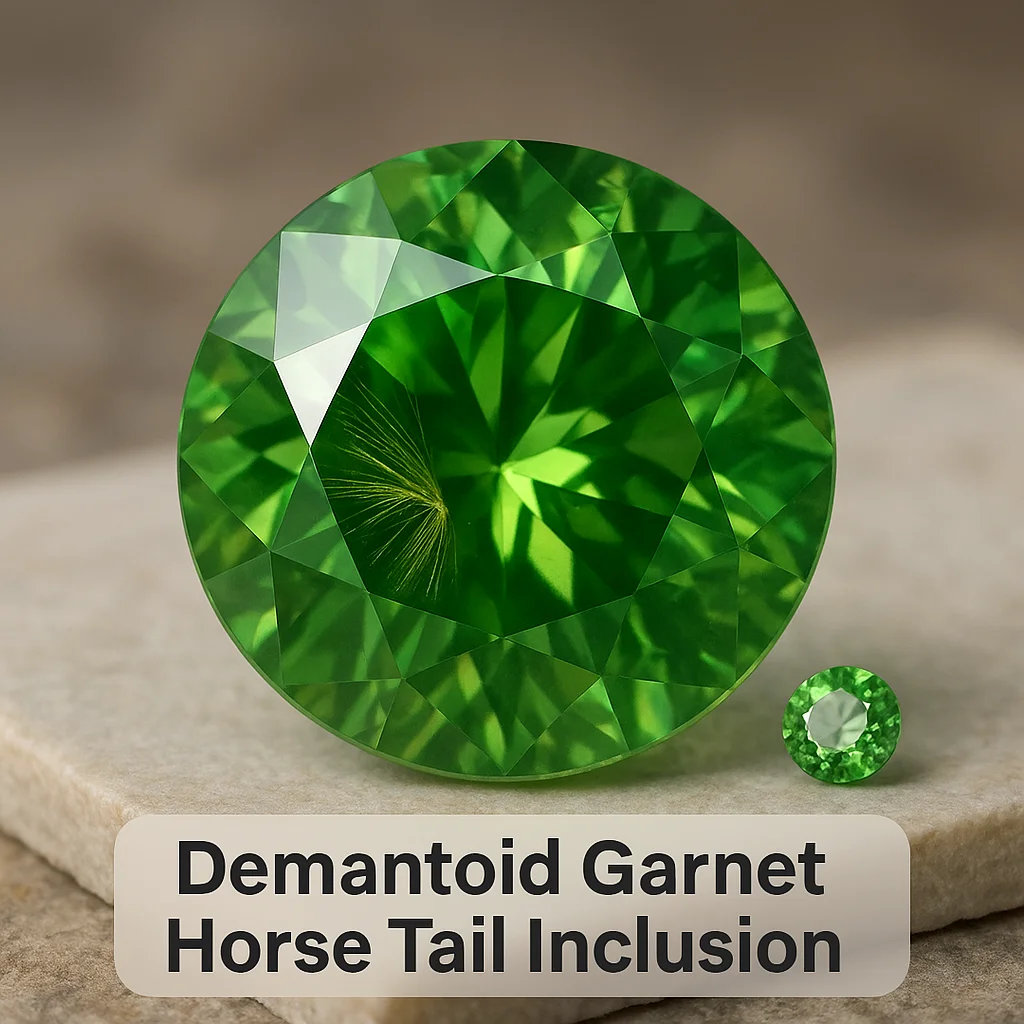
Belonging to the broader garnet family, demantoid garnets are admired for their extraordinary brilliance and fire. This brilliance is due to their high refractive index, which measures how much a gem can bend light. Demantoid garnets are especially sought after in jewelry, adding a touch of elegance to various pieces.
This article will help beginners understand the demantoid garnet, covering topics like its appearance, properties, origin, value, care, and buying tips. Demantoid garnets are not used as contemporary birthstones, but they remain popular in certain jewelry circles for their unique beauty.
🌍 Where It Comes From
Demantoid garnets are typically found in metamorphic rock environments. These environments are known for having the heat and pressure necessary for the formation of these exquisite gems. Within these geological settings, demantoid garnets can develop, incorporating unique inclusions that become part of their charm.
The most notable sources of demantoid garnets are found in Russia and Africa, including countries like Namibia and Madagascar. The Russian demantoid garnets are especially famous for their vibrant green hues and distinct horse tail inclusions.
Origin can play a significant role in the desirability and value of demantoid garnets. Gems from Russia, in particular, often command higher prices due to their distinct color and clarity. However, garnets from other regions can be equally beautiful and valuable depending on their quality.
🔬 How It Forms
Demantoid garnets form through geological processes involving heat and pressure over extended periods. These conditions enable the minerals to crystallize, creating the stunning green gems that are sought after in the jewelry world.
The unique green color of demantoid garnets is typically caused by trace amounts of chromium and iron within their crystal structure. These elements are responsible for the range of green hues that vary from light to dark shades.
Demantoid garnets commonly exhibit a crystal habit that includes dodecahedral shapes. Often found with the characteristic horse tail inclusions, these gems present a lush and appealing visual aspect for collectors and jewelers alike.
🎨 Color and Look
Demantoid garnets are prized for their vivid green colors, which can range from light yellowish-green to deep forest green. The presence of the horse tail inclusion, composed of byssolite fibers, further enhances their visual appeal. These inclusions are often seen as indicative of high-quality stones.
The appearance of demantoid garnets can be affected by factors such as cut and clarity. A well-cut demantoid garnet will enhance its inherent brilliance and play with light. However, demantoid garnets typically do not undergo treatments like heat or irradiation, making their natural beauty a significant selling point.
Lighting can also play a role in how demantoid garnets are perceived. They may look different in natural versus artificial lighting, with their fire and brilliance often best seen under natural light conditions.
🧪 Properties That Matter
The Mohs hardness of demantoid garnets is around 6.5 to 7, making them moderately scratch-resistant. This hardness allows for their use in various types of jewelry, though care should be taken to avoid harsh impacts that could fracture the gem.
In terms of toughness, demantoid garnets are considered to have fair to good resistance to chipping, making them relatively suitable for everyday wear when set in protective settings, like pendants or earrings, rather than rings.
The luster of demantoid garnets is typically vitreous, meaning they have a glass-like shine. This luster, combined with their transparency, enhances their visual appeal, making them a popular choice for jewelry pieces that are meant to stand out.
✨ Meanings, Birthstones, and Culture
While demantoid garnets are not officially designated as birthstones in the modern list, they have their place in cultural and folkloric traditions. Traditionally, garnets have been associated with notions of protection and strength, often used as talismans to safeguard the wearer.
In terms of cultural significance, demantoid garnets have been linked to Russian nobility, as they were favored by the Russian elites in the 19th century. They were often set in ornate jewelry pieces with intricate designs.
Although not directly tied to any zodiac sign, garnets in general are sometimes linked to the month of January as a birthstone, symbolizing principles of balance and harmony.
🧼 Care and Cleaning
Taking care of demantoid garnets involves gentle cleaning with mild soap and water, avoiding harsh chemicals that could damage the surface. Use a soft cloth to dry and polish the garnet to maintain its luster.
It is advisable to avoid exposing demantoid garnets to rapid temperature changes or prolonged soaking, as these conditions can potentially affect the stone's integrity.
For storage, keep demantoid garnet jewelry in a cloth-lined box or pouch to prevent scratches from contact with harder gemstones or metals. This will help preserve the stone's appearance over time.
🛒 Buying Tips and What to Check
When buying demantoid garnets, factors such as color, clarity, cut, and carat weight significantly impact their value. Of these, color and the presence of horse tail inclusions are highly valued attributes.
Buyers should inquire about any treatments the gem has undergone and seek certificates for higher-value demantoid garnets to ensure authenticity and quality. It’s important to confirm that the stone's origin matches the seller's claims, especially if purchasing Russian demantoid garnets.
When purchasing online, examine photos carefully, check the seller's reputation, and ensure a robust return policy is in place. This will help safeguard against dissatisfaction with the final product.
⚠️ Real vs Fake and Common Look-Alikes
Natural demantoid garnets can be distinguished from synthetic or imitation stones, such as glass or plastic, through their unique inclusions and optical properties. Lab-grown garnets may lack the characteristic horse tail inclusion, which is often used to verify natural origin.
Common look-alikes include other green gemstones like peridot or tourmaline. However, these stones generally have different refractive indexes and inclusions, which can be identified by a professional gemologist.
For reliable identification, professional testing is recommended, as it can confirm authenticity and distinguish between natural, synthetic, and imitation stones.
❓ Common Questions and Misconceptions
Is it a mineral or a rock? - Demantoid garnet is a mineral.
Is it a birthstone? - Not traditionally, though garnets are considered the birthstone for January.
Will it scratch easily? - With a hardness of 6.5 to 7, it has moderate scratch resistance.
Can it go in water? - Yes, but avoid prolonged soaking and expose to gentle conditions.
Does color fade in sunlight? - Generally stable, but should not be left in strong sunlight for extended periods.
What treatments are common? - Typically none; they are valued for their natural appearance.
Is lab-grown 'fake'? - No, but it’s distinct from natural stones and should be disclosed as synthetic.
How do I store it safely? - Use a cloth pouch or box to prevent scratching.
Do inclusions always lower value? - In the case of demantoid garnets, horse tail inclusions can enhance value.
How do I pick a good one for jewelry? - Look for vivid color, brilliance, and characteristic inclusions.
📌 Summary
- Demantoid garnet is a green variety of garnet known for its brilliance and unique horse tail inclusions.
- Typical colors range from light yellowish-green to deep forest green.
- Forms under high heat and pressure, with chromium and iron contributing to the color.
- Hardness of 6.5 to 7; suitable for jewelry but requires careful wear.
- Natural appearance is valued; treatments are uncommon.
- Clean with mild soap, avoid harsh chemicals; store to prevent scratches.
- Ideal for pendants and earrings due to brilliance and color.
- Common look-alikes include peridot and tourmaline; professional identification advised.
- Authenticity is confirmed through presence of characteristic inclusions and professional testing.
- Buying tips: verify origin, check seller reputation, ask for reports.
- Garnets are traditionally January birthstones; demantoid offers unique allure.
- Takeaway: Horse tail inclusions enhance value, offering a distinct verification marker.